
Absence management and resource planning for Redmine.
The HRM plugin manages holiday leave, sick leave and working time models, and thereby answers the question of who a team can count on in the coming weeks.
Attendances are recorded as coming and going, absences with an approval process, public holidays per region. This results in the available capacity for each day, and the resource view shows where the planning does not add up.
What it is not: not a payroll system, not a time management system with time accounts and carried-forward balances, not an access control system.
If you have more than a handful of employees to take care of, you know that you can no longer devote yourself only to important tasks, customer projects or inquiries. Your daily life also includes
- Attendances to manage,
- to record leave requests and other absences,
- Check hourly bookings
- and to plan the resources for upcoming projects.
Ideally, a large part of the activities should be delegated directly to your employees (keyword: Employee Self Service).
All functionalities that our extension for Redmine has already integrated from the beginning.
Booking attendances
Every booking belongs to an attendance type that you define yourself: office, home office, field work, holiday leave, sickness, training. The event type decides whether the time counts as working time. Besides attendance and absence there is absence (time off), for example for unauthorized absence during working time.
A distinction is made in the calculation between employees with or without a booking obligation for attendance.
Employees who are not required to book attendance merely store their planned absences in Redmine (e.g. vacation) to support realistic resource planning. Or in the case of unplanned absences (e.g. illness) to inform their superior or his representative or the human resources department directly (digitally). Without detours in a centrally accessible system.
Employees who are required to book attendance are requested to enter their working times digitally (that is, within Redmine). Superiors and HR then see the booked attendances directly in the system, without collecting spreadsheets. Absences requiring approval such as holiday leave run through the same paperless process. The decision (accepted/rejected) is available for the employee to view directly in their user account.
The following screenshot shows the area Attendance in the user account of an internal employee in Redmine This area is not only used to enter attendances or absences, but also to create reports on time sheets or to check whether absences requiring approval have been accepted or rejected.
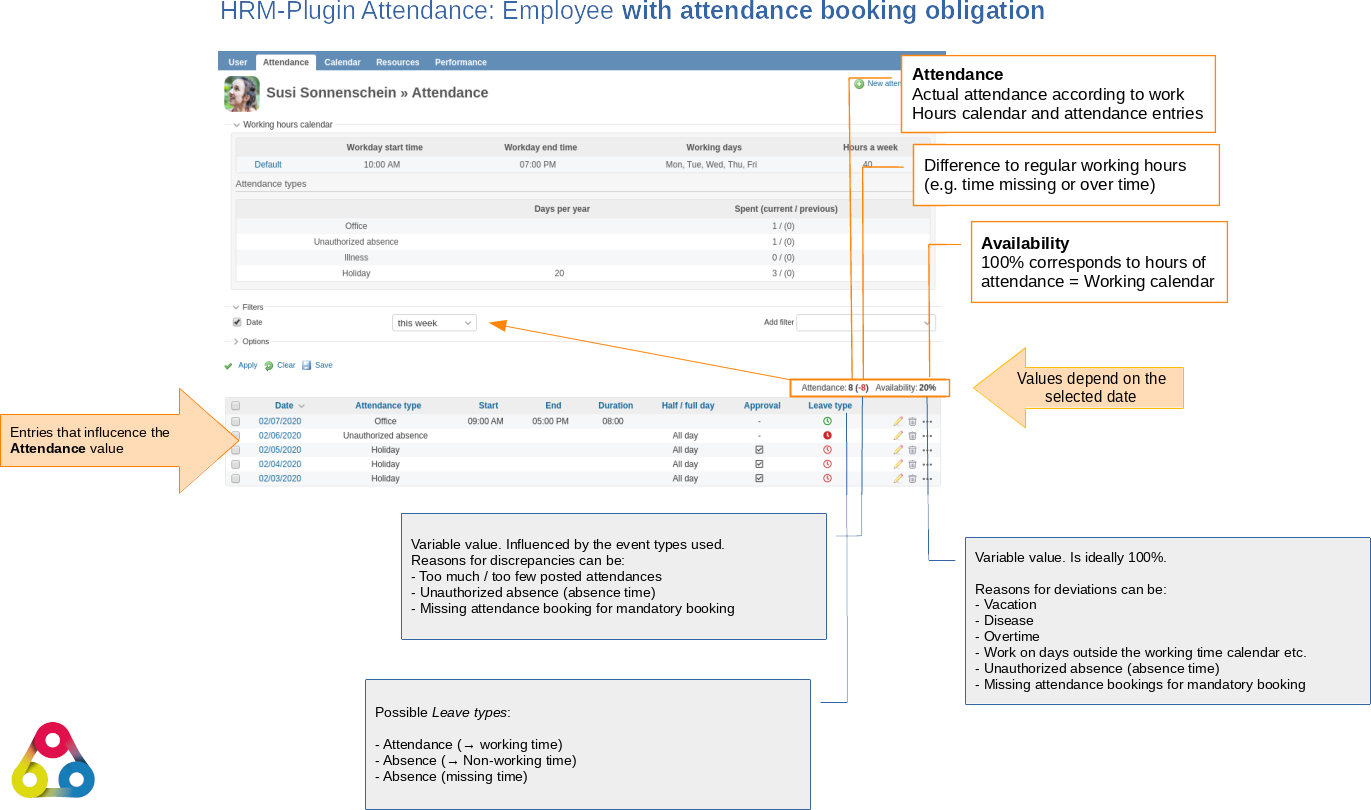
Illustration shows the “Attendance” view of a bookable employee in Redmine
Advantages of the Redmine HRM Plugin
Anyone who has managed their staff using Excel will quickly see the benefits of a solution seamlessly integrated with Redmine.
Where previously only one person worked on the document, the HRM plug-in allows multiple employees to access the relevant data to manage their workforce.
Where previously only the Human Resources department was responsible for checking the presence of employees, the HRM plugin now also allows managers to access the presence of their team members. In addition, employees themselves are now able to post attendances and absences, giving them more personal responsibility.
Anyone who previously submitted and processed leave requests in paper form now uses the simple workflow of the HRM plug-in. The digital approval process saves paper and creates more transparency.
Digital time recording: What used to be done by a time-punch clock is now done by modern software applications. Employees can now record their working hours flexibly from anywhere simply via the Internet browser in an online application provided by your company.
Attendance and home office are not contradictory
Anyone working from home books their attendance just like in the office. A browser is enough, nobody needs a terminal or a time clock.
That way the team sees who is available when, and the planning holds up across distributed locations. Public holidays are handled per region, so a Bavarian holiday does not remove colleagues in Hamburg from the planning.
If somebody permanently deviates from the agreed working time, this becomes visible in the attendance overview. For us this is above all a planning signal: anyone constantly working more has too much work and too little support.
What the plugin does not do
We would rather tell you up front what is not possible.
Overtime. The plugin shows the deviation from the agreed working time, but it does not keep an overtime account. The value is recalculated for the selected period every time and is not stored. If you need it permanently, export the attendance list regularly as CSV, XLSX or PDF.
Remaining leave. The holiday leave entitlement starts anew every year on 1 January. Days that were not taken expire. If you want employees to carry over remaining days, you transfer them manually for each employee before the turn of the year.
Breaks. What is recorded is the attendance period including breaks. There is no automatic break deduction. If breaks need to be shown separately, create a dedicated attendance type for them.
Historical values. All calculations run at runtime against the currently assigned working hours calendar. If an employee switches from part-time to full-time, past values change as well. Export evaluations that need to last before making such changes.
Payroll. The plugin does not calculate wages and does not feed data into a payroll system.
If you want to test the features of the Redmine HRM plugin, you can do so in Redmine Online-Demo. All functions of the HRM Plugins can be found on the product page. We are happy to help with specific questions.